






Why your ergonomics program isn't working. And what to do about it.
Know why annual surveys, audits, and physio referrals still fail, and how to fix each gap.
 Health
  Setup
Setup 
If your organization addresses ergonomics risks via annual self-assessment risk surveys sent to employees, yearly compliance audits done by safety officers or by sending employees who file a medical complaint to physiotherapists, this article is for you.
Even if well-funded, most ergonomics programs that follow this path will eventually fail, injuries will still happen, medical costs will keep rising, and employee productivity will keep falling.
Here are the six reasons most corporate ergonomics programs fall short and the quick fixes for each:
1. The program is reactive, not preventive
The corporate safety program only activates after an injury occurs, a claim is filed, or a regulator asks questions. By that point, the musculoskeletal disorder has already developed and the medical leave has begun.
A proactive ergonomics program:
- Assesses job tasks and physical postures before injuries occur rather than after.
- Identifies risk factors in the workstation, the workflow, and the worker’s posture before they turn into a medical claim.
- Uses baseline data to prioritize high-risk jobs and people, and tracks injury patterns over time.
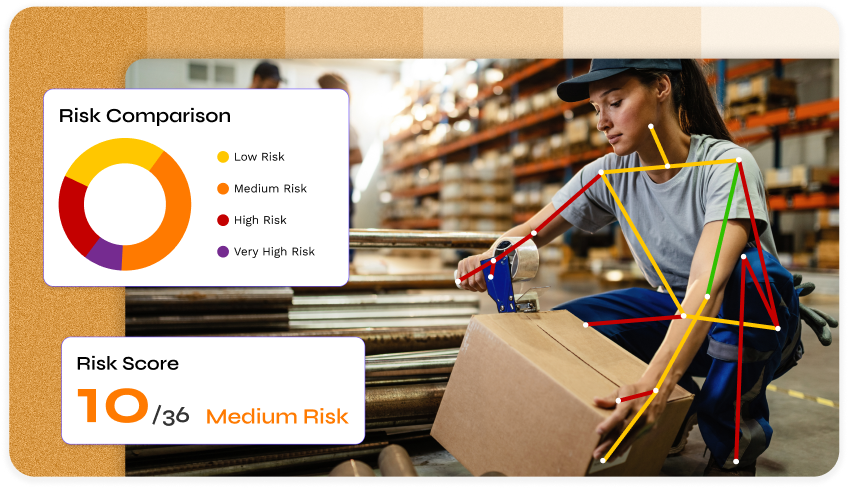
The fix: Use software to complete a professional-grade risk assessment with a quick photo or video upload for each job type in less than sixty seconds.
2. The primary onus of risk-management is on expensive, external experts
The global supply of qualified human ergonomists has remained flat for decades. For example, in the USA, the ratio of qualified ergonomists to employees is as skewed as 1:163,000. However, the demand for workforce injury prevention has exploded. Depending entirely on a limited supply of external consultants for basic baseline assessments is expensive, slow, and hard to scale.
A scalable ergonomics program:
- Creates the first line of defense with its own staff trained by ergonomics experts
- Uses professionally designed software to streamline risk management
- Adopts AI + human approach to offer professional ergonomics expertise without requiring huge budgets
The fix: A hybrid approach that allows safety teams using basic training and a reliable software to conduct professional-quality ergonomics risk monitoring without specialist dependence, requiring external human experts rarely and only for high-complexity situations.
3. Risk coverage is selective, not comprehensive
External specialists that can only audit three to five desks a day, depending on their physical availability, are hired. This means that a full company rollout takes months and early data becomes completely outdated, causing ergonomics risk coverage to be lop-sided and unreliable.
A comprehensive ergonomics program:
- Assesses every employee & job type.
- Re-assesses employees when workstations change, roles change, or employee health conditions change.
The fix: Use fast, self-service tools that let employees audit their own setups immediately to ensure full coverage and democratize assessments.
4. Reports are too technical or impractical to act upon
The traditional, expert-led assessment summaries are usually full of jargon and recommendations that are not actionable. E.g. “Allow 90-degree hip flexion” incorrectly assumes that the chair is fully adjustable, that the employee knows how to operate the levers, and that someone will follow up to audit the change. This isn’t practical and will likely not be acted upon. Many times, the solutions are academically correct but way too expensive.
Instead of “Adjust to allow 90-degree hip flexion,” write “Sit high enough such that the hips are above your knees.”
A pragmatic ergonomics program:
- Uses simple, everyday language that any regular employee and management can easily understand.
- Produces clear recommendations tied directly to specific actions and strict timelines.
- Provides prioritized, creative, low-cost solutions that a company can actually implement.
The fix: Verify samples of past reports before hiring an ergonomist or a software tool. This will ensure that you will get understandable, practical and budget-friendly recommendations that can be actually implemented.
5. One-time training is seen as a solution to ergonomics problems
Many programs incorrectly treat poor ergonomics as a knowledge problem rather than a behavioral habit or a workspace design limitation. However, satisfying safety obligations with a long, annual risk survey or a few breakroom posters fails to change daily user behavior because employees often forget about ergonomics during their busy routines. Or adopt poor postures because the work environment is designed suboptimally.
A practical, ergonomics training program:
- Focuses on micro-habits and short-form videos calibrated to the individual’s specific workspace setup and risk profile.
- Delivers short, frequent & personalised nudges to employees as their situation changes
- Does not treat ergonomics training as a silver bullet that will solve all problems and also embraces periodical design improvements and in-person workstation assessments
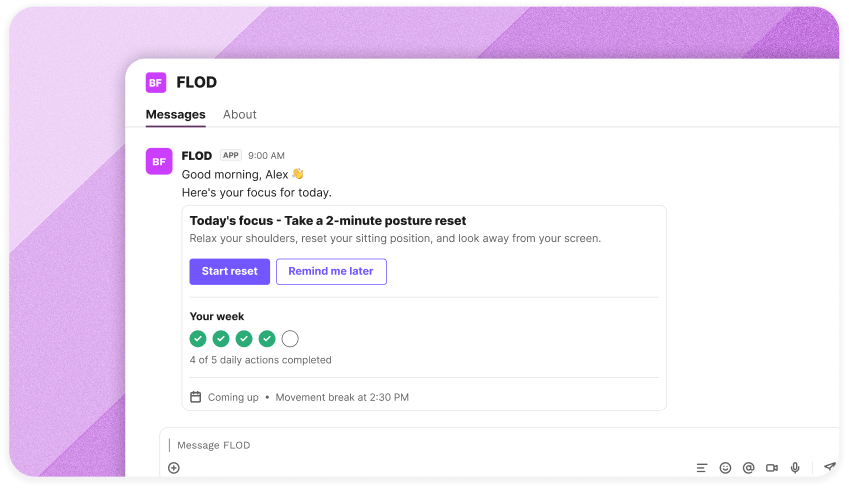
The fix: Use a professionally designed learning system that provides personalized training based on employees’ individual risk profile. Plus bite-sized ergonomics coaching prompts straight to employees’ screens via modern interfaces like chat-bots.
6. ROI is unknown or not analysed.
Programs that run purely on the interest or conviction of a few people in the management may not receive adequate budgets or sustain in the long run. Without clear data relating to the financial impact of the ergonomics program on strategic business outcomes such as lowering compensation claims, downtime, absenteeism, etc., management may not know how to continue or steer the program.
A well-evaluated ergonomics program:
- Defines clear and measurable metrics
- Provides a central analytics dashboard that displays organizational risk levels and compliance statistics in real time across jobs, geographies and timelines
- Uses solid financial data to map ergonomics budget spend directly against a reduction in impact costs such as accidents, loss of productivity, etc.
The fix: Implement a transparent metrics dashboard so leadership can see that continuing ergonomics efforts lead to measurable and positive business outcomes.
To sum up
If your ergonomics program is reactive, underperforming, under-reported, and under-resourced, the answer isn’t to spend more on the same approach. It’s to rethink the model and get a better ROI.
Platforms like BalanceFlo now exist to make ergonomics program management efficient, affordable, and accessible to every company and worker in the world. The only thing left is the decision to do things differently.

 Fitness
 Ergo Hacks
  Posture
 Equipment